INITIATION LOOP
A First-Person Puzzle Experience
Summary
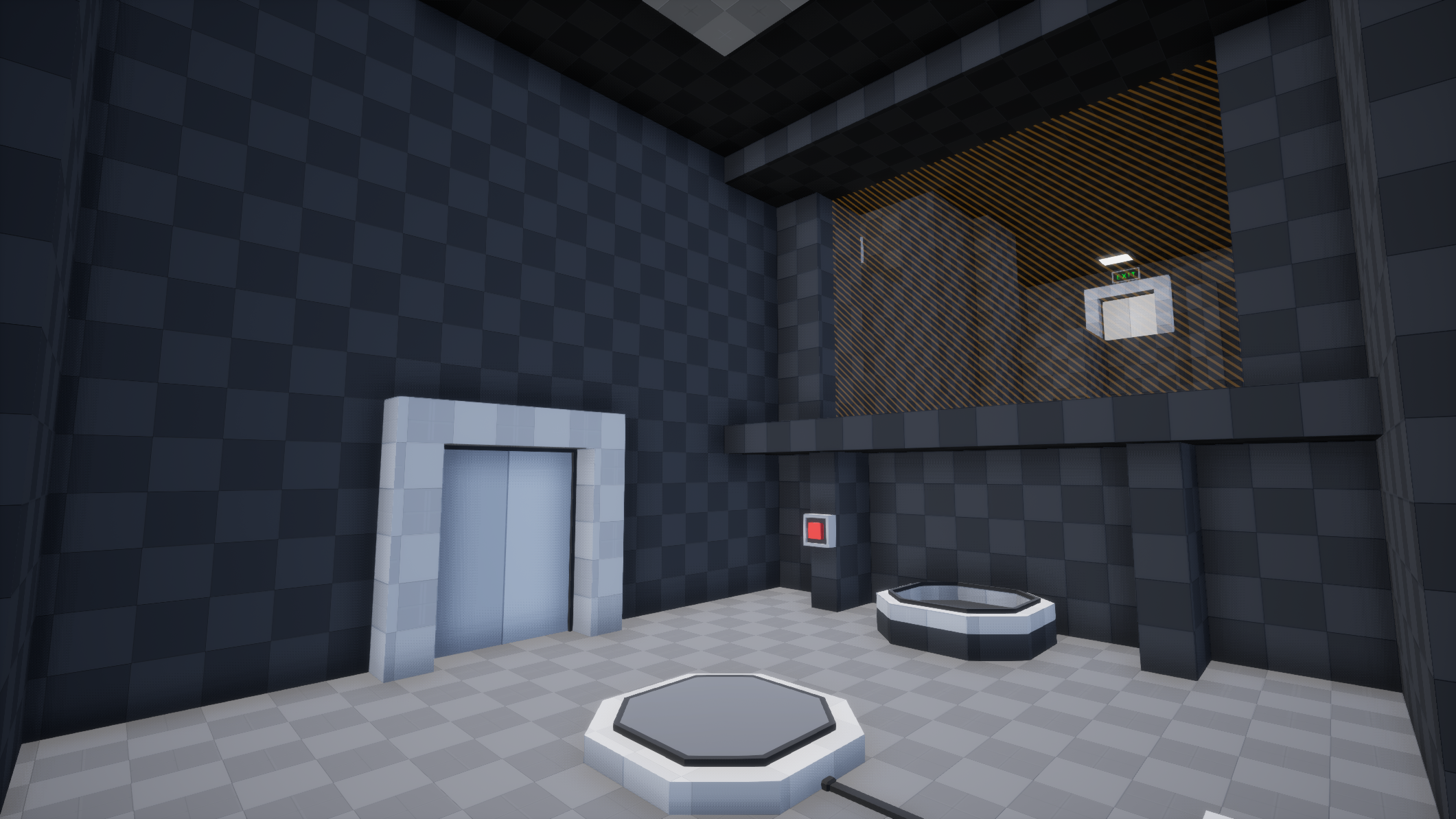
Initiation Loop is a first-person Portal-inspired puzzle experience where you solve different puzzles. The level focuses on onboarding the player the necessary mechanics.
Goals
Teach the player new mechanics throughout the level
Create unique and fun puzzles
Balanced rise of difficulty
Project Breakdown
Solo project
4 weeks half time
Unreal Engine 5.6
KytanDev’s Portals Puzzle Template
Level overview

1 - First Introduction
2 - Introducing Portals
3 - Object Through Portals
4 - Keeping Momentum
5 - Barriers That Block
6 - Portals Through Barriers
7 - Introducing Lasers
8 - Lasers Through Portals
9 - The Final Puzzle
Playthrough
Puzzle Mechanics
Pressure Plate
Must have an object on it to be able to send power. Can power doors, spawners and platforms.
Button
Can send power to doors, spawners and platforms.
Laser Box
Physics-based, can be picked up, placed down and used to redirect lasers.
Laser Receiver
When receiving a laser it can power other objects.
Barriers
Three different barrier types that block specific things.
Orange Barrier blocks physics objects
Blue Barrier blocks the player
Red Barrier blocks both physics objects and the player
The Cube
Physics-based, can be picked up, placed down and used to activate pressure plates.
Portals
Can open up blue and red portals on white walls.
Laser Emitter
Emits a laser that can be received by a receiver or redirected. The laser can harm the player.
Spawner
When powered it can spawn cubes or laser boxes.
Own Guidelines
Some own guidelines that I’ve made for myself and that I had in mind when designing the various puzzles in the project
Clear goal
Always when entering a new room, the exit from the room should be presented clearly. The player should never get the feeling of not knowing where the goal is when entering a new room.
Pieces visible
When entering a new area the necessary puzzle pieces required to progress should quickly be visible so the player can start solving the puzzle.
Simple & compact
To avoid clutter, strive for simplicity in rooms, no unessecary elements or spaces. Remove all unnecessary elements and spaces until only what is important to the puzzle remains.
“AHA” moments
The problem with the puzzle should be obvious from the start, but the solution should not. But once the solution is understood, the puzzle is easy to solve. Design for “aha” moments.
Onboarding
Few at a time
By introducing mechanics few at a time in a safe environment I allow the player to explore and develop a deeper understanding of each mechanic on their own.
Teaching without telling
Learning new mechanics shouldn’t depend on walls of text, it should be hands-on, engaging, and fun to discover. It’s more fun to actually try it out for yourself and it is easier to learn by doing.
Cause and effect can be a useful teaching tool. When a player does something and immediately sees a clear result, they naturally understand the rule behind it. This makes learning faster and more intuitive because players remember what they experience rather than what they are told.
In the first room, I introduce the pressure plate, button, and spawner. The button and spawner are initially concealed to focus attention on the door and pressure plate. This enourages experimentation and lets the player discover what the pressure plate does on their own.
Stepping onto the plate opens the door, establishing a clear cause-and-effect relationship. While standing on the plate, the button and spawner are revealed, opening up for more experimentation. The player learns how the different elements function by using them, they learn by doing.
First Introduction
Introducing Portals
In the second room, portals are introduced but also a new problem, to get over to the other side. By introducing a simple problem the player is required to use and learn how to use the portals to progress.
This provides a simple and intuitive introduction to using portals and understanding the mechanic.
The third room introduces that objects can move through portals. To solve the puzzle, the player must place the cube on the plate. Retrieving the cube requires jumping into the hole, and the only way to escape the hole is by using the portals.
The puzzle encourages the player to move objects through the portals while naturally teaching the interaction between objects and portals.
Objects through portals
Keeping momentum
The fourth room introduces the concept that players and objects retain momentum when traveling through portals. To progress, the player must move both themselves and a cube across a gap.
Incorporating a fall in the puzzle leverages the player’s intrinsic knowledge of physics, such as gravity and momentum, while also building on the previous puzzle that involved taking objects through portals.
The fifth room introduces blocking barriers that prevent physics objects from passing through, adding an extra challenge while reinforcing the concept of momentum carrying through portals.
The player must use momentum to get the cube out from the enclosure, and the barrier increases the difficulty, encouraging more problem-solving.
Barriers that block
Portals through barriers
The sixth room reinforces the mechanic of placing portals through barriers. It also introduces player blocking barriers. To solve the puzzle, the player must get both themselves and a cube to the other side of the barrier.
By first moving past the barrier, the player can then use portals to transport the cube across and complete the puzzle. To emphasize that portals are required to move the cube, I incorporated a dropdown to the other side, hinting the player to use portals to progress because they can’t go anywhere else.
The seventh room introduces the interaction between laser emitters, receivers and laser boxes in a safe environment. A problem is presented, get to the other side of the lasers.
To complete the puzzle, the player must use a laser box to redirect the laser into a receiver to open the exit door. The spawner is initially concealed to focus the player’s attention on the emitter and the exit door, before revealing the solution, the spawner.
Introducing lasers
lasers Through portals
The eighth room introduces the possibility for lasers to travel through portals. The required receiver that needs to be activated to open the exit door is introduced early on to highlight its importance.
To get the needed laser box and complete the puzzle, the player must activate a spawner by causing a laser to travel through two portals. Then the player can use the laser box to open the exit door.
A Problem & A Solution
BEFORE
AFTER
Divided Room
One issue I ran into while designing one of my rooms was that players felt the space was too divided. In the separate room, the objective was to get the cube out of the room and place it on the pressure plate, which would then allow the room’s exit to open. But this failed to give the experience I was aiming for. Instead, I wanted the puzzle room to feel cohesive as if everything existed within a single, connected space rather than sections that felt too seperated.
Minimal Mental Map
This approach helps players maintain a minimal mental map, keeping their focus on solving puzzles rather than on navigating the environment.
When the space isn’t divided, it’s easier for players to see and understand all the puzzle elements at once. Introducing multiple sections risks shifting the players focus towards navigation instead of actual problem solving.
Establishing guideline
This realization led me to establish an early design guideline for myself that I followed throughout the project, keep it simple and compact to minimize unnecessary distractions and help maintain the players focus.
Modular Workflow
For this project, I chose to design each puzzle in a separate test environment rather than building everything directly in the main level. Once a puzzle was ready to be integrated, I transferred it into the main level. This approach made the overall building process much more manageable.
It allowed me to focus on each puzzle individually and iterate more effectively based on player feedback. I was able to refine them until they reached the right balance of fun and challenge, avoiding both boredom and frustration.
This approach also made it easier to make larger changes in the main level without consuming large amounts of time. The puzzles were organized and grouped in the test environment, allowing me to quickly make changes to the level when needed based on player feedback.
Reflection
Puzzle design is a part of level design that I have not explored enough. But through this project I have learned more about this part of level design. I have also learned that designing puzzles is difficult, especially if you are not so familiar with it. There has been a lot of staring at the screen as you just sit and think about how to best design puzzles. Nonetheless, it has been rewarding to have people playtest my puzzles and observe their thought processes and reactions as they worked to solve them. There’s a satisfying feeling when they solve a puzzle exactly as intended.
If I were to redo the project, I would consider incorporating more story elements into the experience. While the main focus of this project was to teach the player in a fun and diegetic way, adding narrative could have made the experience even richer. Of course, doing so might have required extending the project timeline. Nevertheless, I think it would have been interesting to combine storytelling with the puzzle genre. Additionally, connecting the puzzles more closely to the surrounding environment could have strengthened the overall cohesion and immersion of the experience.
As a closing thought I am satisfied with what I have created and learned along this challenging way.
I appreciate you taking the time to read. Thank you!
//Albin